US treasury secretary says deal with Iran to reopen Hormuz could be sealed by Wednesday
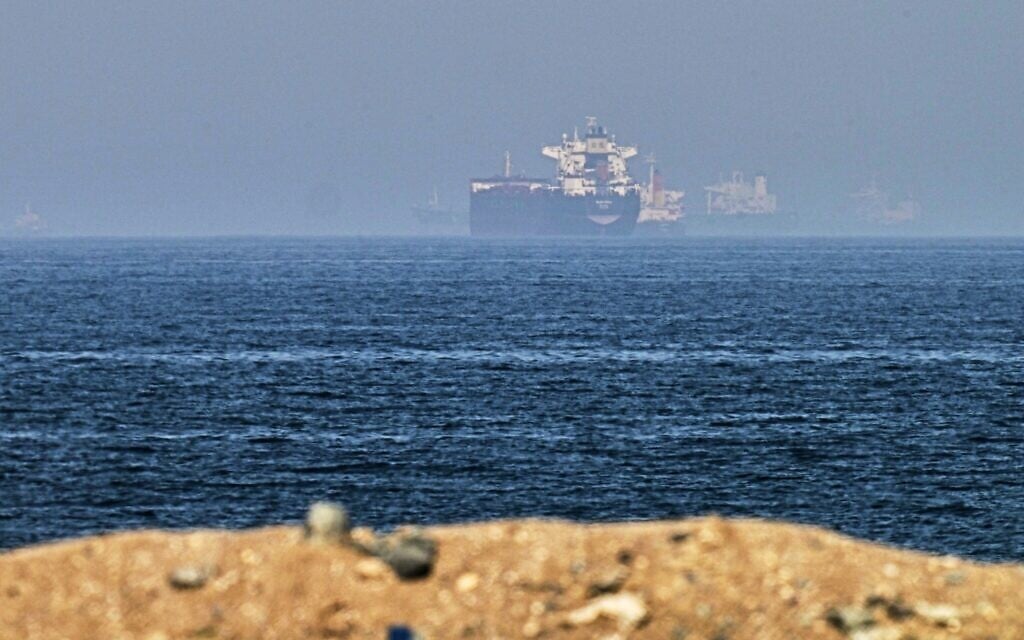
US Treasury Secretary Scott Bessent said Washington could reach a deal with Tehran to reopen the Strait of Hormuz by Wednesday, amid reports that an emerging Iranian-Omani deal on the waterway would hand the Islamic Republic unprecedented control over it.
Speaking to CNBC on Tuesday, Bessent was upbeat that energy prices could stabilize as a result of a US deal with Iran on the blockaded strait, where he said hundreds of ships are waiting to leave.
“We are in talks with the Iranians, and I think there is a chance we may have a deal today or tomorrow to open the strait and move towards a more normalized position in this conflict,” Bessent said.
“Even though things are still a little dicey there over the past few days, we’ve (seen) quite a few ships coming out even now,” Bessent said. “So you know, I’d expect the energy prices to settle back down, which, as I said, will be good for the entire world.”
Asked if a deal would allow Iran to charge a toll on shipping using the strait, Bessent said: “I think it would be freedom of movement.”
US Treasury Secretary Scott Bessent says deal with Iran on Strait of Hormuz may happen 'today or tomorrow'. pic.twitter.com/ZtnnROfJIe
— Aditya Raj Kaul (@AdityaRajKaul) August 4, 2026
However, Iranian officials cited by the New York Times on Tuesday said that under a deal that Iran and Oman are close to signing, ships crossing the strait into the Persian Gulf would be required to pay “service fees,” with Iran and Oman sharing the revenue equally.
The pact would have ships heading toward the Persian Gulf cross the strait in a route that’s close to Iran’s coast and controlled by the Islamic Republic, according to officials familiar with the emerging deal, the Times said.
Vessels going in the opposite direction, leaving the Persian Gulf, would use a route through the strait near Oman’s coast.
The report was unclear on who exactly is negotiating the deal and whether the United States is involved. It cited a US official as casting the Iranian description of the deal as “not accurate,” asserting that any routes the US agreed to would not require Iranian approval or include tolls.
A senior Iranian source told Reuters that Iran wants control over inbound shipping through the strait and visibility over outbound traffic, with the ability to intervene if necessary.
The source, who is involved in the talks, said this is “the general idea currently being discussed,” and specified that the outbound lane would follow a route between Iran and Oman, with exit clearance granted through Oman after notifying Iran.
“Tehran is unlikely to change its position,” the source added.

Until the recent war, the Strait of Hormuz operated for decades as a free international waterway, but it has become a major sticking point in efforts to end the war. Since a ceasefire broke down, Iran has resumed a blockade of the critical trade corridor it first imposed early in the war, obstructing vessels attempting to pass and firing on commercial ships.
On Tuesday, a cargo vessel was struck by an “unknown projectile” in the strait off the coast of Oman, a British maritime agency said, without giving specifics on damage or injuries.
The vessel, which has not been named, reported being “hit by an unknown projectile” and authorities were investigating, the United Kingdom Maritime Trade Operations said, adding that the incident occurred 20 nautical miles (37 kilometers) northeast of Al Khasab, Oman.
The ship suffered damage, according to British maritime security firm Ambrey, which did not elaborate.
Efforts to bring about a diplomatic solution between the US and Iran are “ongoing,” Qatar’s Foreign Ministry spokesman Majed Al-Ansari said on Tuesday.
“We can confirm that efforts are ongoing with all parties; we are looking into a diplomatic solution,” Ansari said.
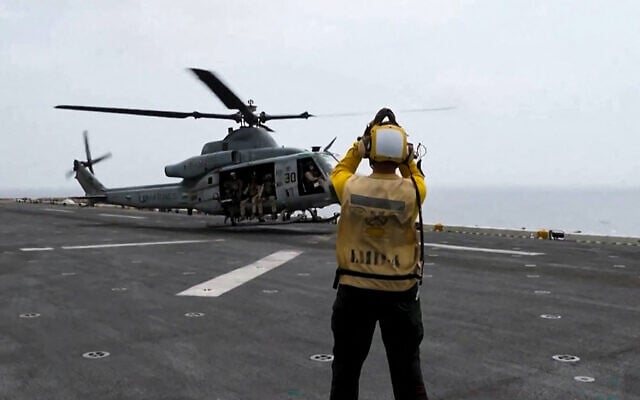
The focus of those efforts is de-escalation and opening the Strait of Hormuz, he said.
Meanwhile, Iran’s President Masoud Pezeshkian said on Tuesday that the Islamic Republic did not want the conflict to widen: “We defend our borders, but we do not seek to expand the war,” he was quoted as saying by state media.
Trump said Monday that talks with Iran had resumed, a day after saying he called off massive strikes that he’d threatened to unleash on the country. Trump said he had pulled back at the urging of Gulf allies Qatar, Saudi Arabia and the United Arab Emirates.
Whether “Iran wants to admit it or not, we are, in fact, talking,” Trump maintained.
Iranian Foreign Ministry spokesperson Esmail Baghaei said Monday that no negotiations were being held with the US, adding that Tehran’s talks were only with Oman and focused on the Hormuz mechanism.
Trump voiced frustration with Iran, suggesting Tehran had asked for the talks.
“Iranian Leadership is unbelievably duplicitous!” the US president vented on Truth Social, his social media platform.
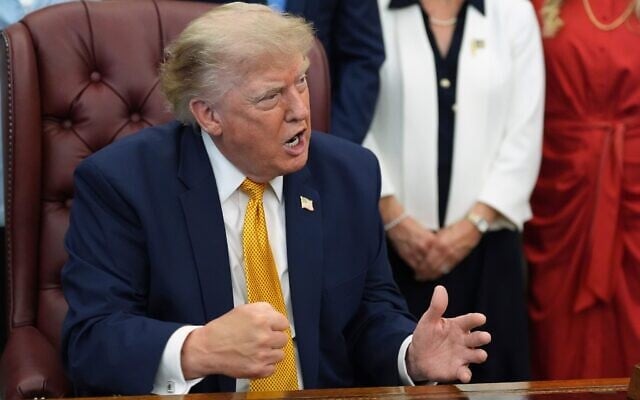
“They ask for a meeting, some would say ‘beg,’ talks begin, with more scheduled in the immediate future, and they say, openly and proudly, that they’re not having any discussions, that nothing is being talked about, and they’re only dealing with ‘Oman,’” he wrote.
Trump may face difficulties maintaining a renewed escalation if he decides to do so, as the US Army has used up much of its stockpile of highly accurate long-range missiles during the war, three people familiar with the data told Reuters.
The missiles are principally the Army’s surface-to-surface weapons, known as Army Tactical Missile Systems (ATACMS) and Precision Strike Missiles (PrSM). The US has used “virtually all” of these weapons, according to two of the sources.
The long-range munitions are an important part of the military’s arsenal, allowing accurate strikes from a safe distance. US-supplied ATACMS have played a key role in the war in Ukraine, allowing Ukrainian forces to attack targets inside Russia. The PrSM is a newer, more advanced generation that will replace the ATACMS, which have a shorter range.
Analysts say such weapons – which cost over $1 million each – would also be important in any conflict with China.
The sources declined to say how many of each munition the US had left.
A person familiar with the matter said that while Central Command — which oversees US forces in the Middle East — has nearly used up the land-based missiles it had before the war began, it has been able to reload from US military supplies elsewhere in the world.
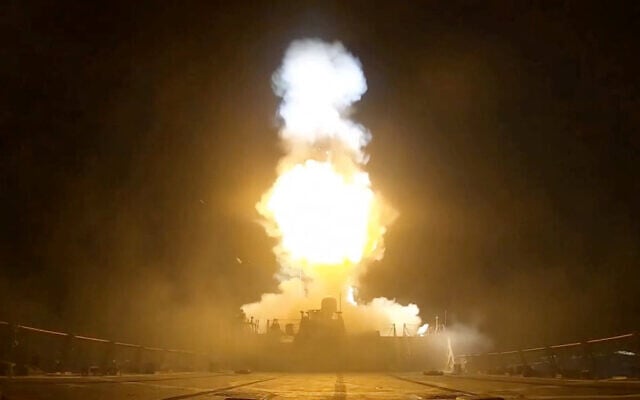
Asked for comment on the stockpile data, the White House issued a statement from Trump, saying the US had “far more munitions than anyone in the world” and “far more than we need.”
“Our defense companies are, at this moment, making more munitions than they have ever made before, in addition to expanding their plants and equipment at record levels,” Trump said.
Analysts agree that certain munitions, including artillery shells and several types of missiles, are being produced at record levels, but caution that supplies might fall far short of what is needed for a prolonged war.
Lockheed Martin, which makes the ATACMs and PrSMs, along with the anti-ballistic missile THAAD system, did not immediately respond to questions about Trump’s statements or about supply levels. Raytheon, which makes Tomahawk missiles and Patriot interceptors, two important US weapons, also did not immediately respond.
Chief Pentagon spokesperson Sean Parnell said: “America’s military is the most powerful in the world and has everything it needs to execute at the time and place of the President’s choosing. We have executed multiple successful operations across combatant commands while ensuring the US military possesses a deep arsenal of capabilities to protect our people and our interests.”
The supply figures have circulated inside the federal government over the last week during tense conversations inside the Trump administration about how much longer the US can continue striking Iran without drawing down the stockpile to levels that would limit the military’s ability to respond to crises elsewhere.
One of the sources said the drawdown of the ATACMS and PrSM stockpiles reflected a decision by the Trump administration to avoid riskier ways of attacking Iranian targets, such as by using piloted aircraft to drop bombs.
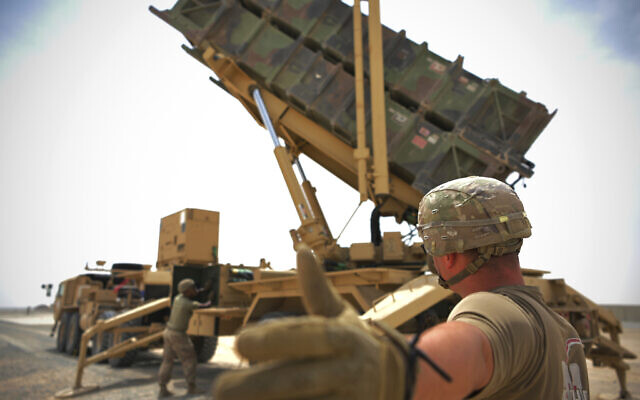
Military leaders have for weeks warned the US president that stockpiles of defensive weapons — including Patriot interceptors, which are effective against ballistic missiles — were dwindling, two of the sources told Reuters. Last week, several media outlets reported Trump had decided not to launch another massive offensive inside Iran in part because his military advisers had warned about the stockpile.
A US official disputed those accounts, saying Trump chose not to move forward with another attack because of pressure from Gulf states.
The Middle East conflict has sparked intense debate about Trump’s authority to prosecute hostilities against Iran without congressional authorization. No request for a declaration of war or an authorization to use military force has been submitted to Congress.
Last week, CSIS published a report estimating that between February and July about 65% of Patriot interceptors were expended, and that the number of THAAD ballistic missile interceptors in US stockpiles was at least 38% lower than at the start of the war. Patriots and THAADs are systems that detect and destroy incoming missiles and are among the most effective in the country’s arsenal.
While Reuters has not seen the supply figures, those numbers match internal US data, two of the sources said.
The US also burned through a little less than half of its global supply of Tomahawk cruise missiles, which are generally launched from ships, since the start of the war, one of the sources said. Reuters could not independently verify that number.

The war with Iran has been draining for all of us in Israel. But when I heard about a high casualty incident – ballistic missile impacts in Arad and Dimona that left nearly 200 people wounded – I drank a cup of coffee, packed a bag, and headed south.
There, I spoke with Shilgit, the head of an after-school program for underprivileged youth. Standing outside her destroyed center, Shilgit said it was a miracle that no children were hurt and spoke about the community coming together in the hours since.
As a Times of Israel reporter, I’m committed to telling stories of resilience like Shilgit’s. But my colleagues and I can't do this alone. If you value work like this, please consider joining our reader support group, The Times of Israel Community. Your financial support is essential to keep real human reporting like this going.
— Stav Levaton, military reporter

We’re really pleased that you’ve read X Times of Israel articles in the past month.
That’s why we started the Times of Israel – to provide discerning readers like you with must-read coverage of Israel and the Jewish world.
So now we have a request. Unlike other news outlets, we haven’t put up a paywall. But as the journalism we do is costly, we invite readers for whom The Times of Israel has become important to help support our work by joining The Times of Israel Community.
For as little as $6 a month you can help support our quality journalism while enjoying The Times of Israel AD-FREE, as well as accessing exclusive content available only to Times of Israel Community members.
Thank you, David Horovitz, Founding Editor of The Times of Israel






US Treasury Secretary Scott Bessent indicated on Tuesday that a deal with Iran to reopen the Strait of Hormuz could be finalized by Wednesday, potentially stabilizing energy prices. He stated, "We are in talks with the Iranians, and I think there is a chance we may have a deal today or tomorrow to open the strait." However, Iranian officials, cited by the New York Times, suggested an emerging Iranian-Omani deal would grant Iran significant control and allow for "service fees" on shipping, a claim a US official called "not accurate." Qatar's Foreign Ministry confirmed ongoing diplomatic efforts for de-escalation and reopening the strait. Meanwhile, reports indicate the US Army has significantly depleted its long-range missile stockpiles, including ATACMS and PrSMs, during the conflict, raising concerns about its ability to sustain prolonged engagements or respond to other crises.
© All rights to the original article belong to the source. Din Online shows a headline, an excerpt and a link only. The objectivity rating is computed automatically and is an estimate only.
Discussion
No comments yet — be the first to comment.